

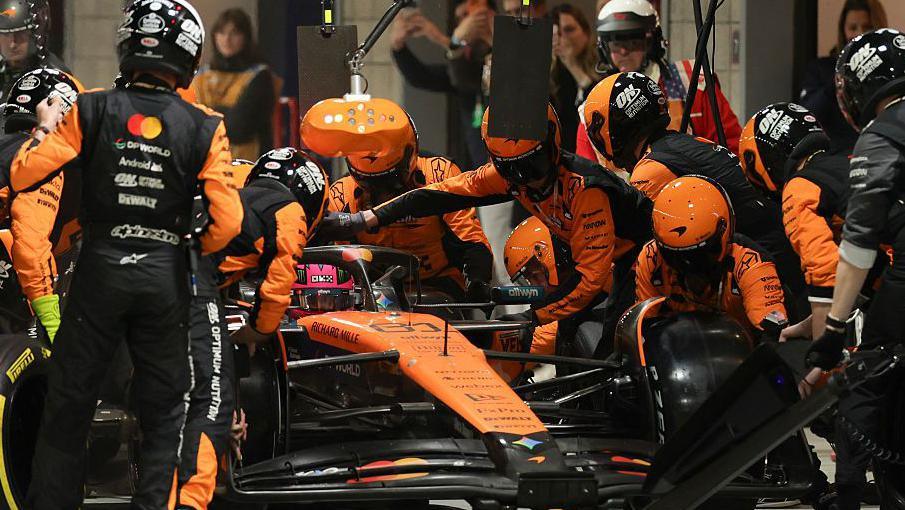
Lando Norris and Oscar Piastri were disqualified from the Las Vegas Grand Prix
The McLaren team disclosed that the problem causing the disqualification of their two vehicles from the Las Vegas Grand Prix was apparent from the beginning of the competition
The two McLaren drivers lost their positions from second and fourth place correspondingly following officials discovered their cars' skid blocks had worn out too much
Technical Issues Explained
Team principal Andrea Stella stated that the team did "not believe we took excessive risk with the vehicle clearance" and that they had "added a protective buffer" intended to reduce skid wear during both qualifying and race
He mentioned the team observed an aerodynamic phenomenon known as "porpoising", where a car oscillates vertically into the track surface, "beginning shortly after the start of the competition"
"The data showed from the recordings that the extent of unexpected porpoising would be a concern," Stella said
"We realized relatively soon that this degree of porpoising was causing a high level of underside damage and this is the reason why Norris and Piastri started to take remedial actions in various parts of the track"
Preventative Actions Employed
McLaren instructed the drivers to use a technique known as 'reducing throttle before corners' before corners in an attempt to reduce the aerodynamic load on the cars at the conclusion of straight sections, when the car is running at its lowest
"Unfortunately, we also saw that, due to the car operating window and the circuit characteristics, most of these actions were not effective enough in reducing the bouncing issue," Stella commented
No further explanation as to the reason behind this has been offered
Understanding Porpoising
With modern Formula 1 vehicles, the bouncing phenomenon is caused by a disruption in the airflow beneath the vehicle
F1 cars use so-called 'venturi' underbodies to accelerate the airflow and create an zone of reduced air pressure that pulls the vehicle to the surface to enhance turn capability
If the underside wind current is disrupted, it stops working as efficiently - or 'loses effectiveness' - causing the vehicle jumping up
This air movement then starts working again, pulling the vehicle downward until the same phenomenon is repeated
This typically occurs about five times a per second
Regulation Details
Stella explained that the problem was caused by "an anomaly in the behaviour of the car, rather than it being the result of an excessive or excessive pursuit of speed"
This protective buffer applied had been "negated by the unforeseen onset of the large vertical oscillations, which resulted in the vehicle to contact the ground"
The principal noted the extent of additional damage on the underside components was "quite small"
- For Norris's vehicle, two of the skids were illegal - a front component by 0.12 millimeters and a rear piece by 0.07mm
- On Piastri's car, three underside elements were reduced beyond the allowed 9mm limit - two front components by 0.04mm and 0.26mm and one rear element by 0.1mm
"Unlike competition regulations, there is no proportionality in the application of sanctions for rule violations," the principal explained
"The FIA itself has admitted that this lack of proportionality should be addressed in the future to guarantee that small and unintentional regulation breaches, with minimal or no competitive advantages, do not result in excessive penalties"
Future Outlook
Stella said he did not anticipate the problem to happen again at this weekend's Qatar Grand Prix
"The circumstances we encountered during the previous event and which resulted in the onset of porpoising and additional contact, relative to what was expected, are quite particular to the performance range of the car in Vegas and the track features"
"We have a thoroughly developed and refined way of setting up the vehicle and we are certain that this will guide us to an ideal plan for the upcoming events, starting from the Qatar track"
Championship Situation
The British driver is ahead of his teammate and the Red Bull driver by twenty-four points with two races left, in Qatar and the UAE capital a week later
Norris will become the championship title on Sunday if he scores two more points than his competitors irrespective of where he finishes, or an extra point if he takes victory on Sunday
The mathematics are complicated by the reality Qatar is a shorter format race with a reduced-distance competition on the previous day in which competitors can earn additional points
Team Philosophy
McLaren have operated their squad this season on a principle that the pilots will be permitted to race with each other for the title for as long as each are theoretically able of securing victory
The principal stated there was "no reason to alter this strategy" before Qatar
"Our position has consistently been that as far as the calculations does not say otherwise, we would leave it up to the both pilots to fight for their chance at the final victory, and that is how it will be in the upcoming race"
"Let's not forget that if someone had informed us at the start of the season that we would be positioned in this situation with two races to go, we would have signed up for it"
"Currently we are preparing to compete for the both championships with assurance and awareness of our strength"